
The Business Opportunities Behind the Global Shift Toward Safer Lithium-Ion Battery Systems
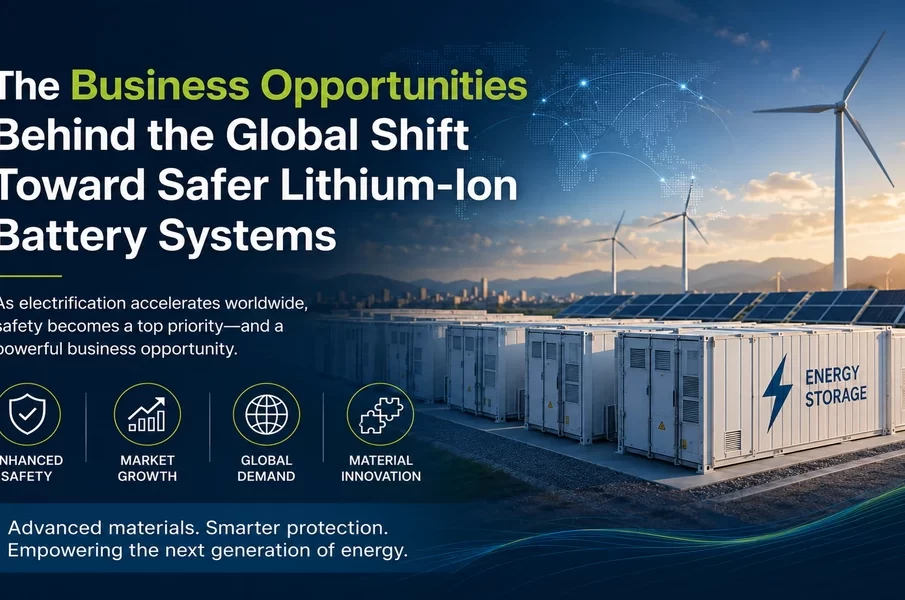
The rapid expansion of electric vehicles (EVs), battery energy storage systems (BESS), consumer electronics, and industrial electrification is driving unprecedented demand for lithium-ion batteries. However, as batteries become larger, more energy-dense, and deployed in greater numbers, safety has become a critical factor shaping the industry.
Battery safety is no longer simply an engineering requirement. It is becoming a significant business opportunity across the lithium-ion battery supply chain, particularly for companies providing insulation, flame-retardant, thermal management, and thermal runaway protection materials.
Battery Growth Is Creating a Larger Safety Materials Market
The transition toward electrification is fundamentally increasing the number of lithium-ion batteries operating in vehicles, factories, homes, commercial buildings, and utility-scale energy storage facilities.
At the same time, manufacturers are pursuing higher energy density, faster charging, longer driving ranges, and more compact battery architectures. These developments improve battery performance but can also create more demanding thermal and electrical operating environments.
A single battery cell failure can potentially release significant heat. Without effective protection, heat may spread to neighboring cells and eventually affect the entire module or pack.
As a result, battery manufacturers are increasingly moving from basic protection toward multi-layer safety strategies.
This shift creates opportunities for material suppliers capable of providing protection at the cell, module, and pack levels.
Cell-Level Insulation Becomes Increasingly Important
At the cell level, preventing unintended electrical contact and improving flame resistance are fundamental safety requirements.
Materials such as PC insulation flame-retardant sheets can provide electrical insulation while helping battery manufacturers improve structural and fire protection around cells and electrical components.
The business opportunity here is closely connected to the enormous scale of battery manufacturing. Every battery pack contains multiple cells and numerous interfaces requiring reliable insulation.
As EV and energy storage production increases, demand for lightweight, thin, process-compatible insulation materials can grow alongside battery production.
For suppliers, competitive advantage will increasingly come from more than simply supplying a standard sheet. Battery manufacturers may require customized thicknesses, dimensions, flame-retardant performance, dielectric properties, and processing characteristics for different battery architectures.
Thermal Runaway Protection Opens a Higher-Value Market
One of the most important areas of battery safety is controlling thermal runaway propagation.
This creates a growing market for advanced thermal barrier materials, including CR foam, nano silica composite thermal insulation boards, and ceramifiable silicone foam.
These materials can perform different functions inside battery modules.
CR foam can provide cushioning, sealing, insulation, and vibration management. Nano silica composite thermal insulation boards can create high-performance thermal barriers between cells or modules. Ceramifiable silicone foam offers another interesting approach: under extreme heat, the material can form a ceramic-like protective structure that helps maintain thermal and fire protection.
This represents an important change in the value proposition of battery materials.
Suppliers are no longer competing only on cost per square meter. They are increasingly competing on how effectively their materials contribute to thermal propagation control, system safety, lightweight design, manufacturability, and long-term reliability.
That creates room for specialized material manufacturers to capture greater value.
Energy Storage Creates Another Major Growth Engine
EVs receive much of the attention surrounding lithium-ion batteries, but stationary energy storage may create equally important opportunities for lithium battery safety material suppliers.
Energy storage systems typically contain large numbers of battery cells installed within modules, racks, cabinets, or containers. Because these systems may operate close to buildings, factories, renewable energy installations, and grid infrastructure, controlling fire and thermal propagation is particularly important.
Unlike automotive applications, energy storage systems may also remain in operation for many years while experiencing repeated charge-discharge cycles.
This creates demand for materials that combine thermal insulation with dimensional stability, flame resistance, compression performance, and long-term durability.
At the pack level, products such as PIR thermal insulation cushioning boards can contribute to both thermal protection and mechanical cushioning, helping create another potential market for multifunctional battery safety materials.
From Material Supplier to Battery Safety Solution Partner
The global shift toward safer lithium-ion battery systems is changing where value is created within the battery supply chain.
Future opportunities will not belong only to battery cell manufacturers. They will also extend to companies providing the materials that help prevent electrical short circuits, delay heat transfer, suppress flame propagation, cushion mechanical stresses, and protect the battery pack as a complete system.
The strongest opportunity may therefore lie in building a multi-level battery safety material portfolio:
- Cell level: electrical insulation and flame-retardant protection
- Module level: cushioning, thermal barriers, and thermal runaway propagation protection
- Pack level: thermal insulation, structural cushioning, and fire protection
As EV and energy storage markets continue expanding, battery safety will increasingly become both a technical requirement and a strategic purchasing priority.